
Brouwerij 3 Fonteinen

Website (Dutch/French/English): http://www.3fonteinen.be
Instagram: @3fonteinen
Facebook: https://www.facebook.com/Brouwerij3Fonteinen?
Lambik-O-Droom contact: +32 2 306 71 03
Address: Molenstraat 47, 1651 Lot
Brewery location (not open to public): Hoogstraat 2 a, 1650 Beersel
Overview

3 Fonteinen is a lambic brewery and blendery located in Beersel and Lot, Belgium. In 2019, Armand Debelder officially retired from the brewery due to severe illness and no longer holds a financial stake, though he is still regarded as the father of the 3 Fonteinen family. 3 Fonteinen is currently headed by Michaël Blanquaert and Werner Van Obberghen, after a nearly 6 year transition that began in 2014. Previously, Armand took over the brewing and blending operations of the business from his father Gaston. There is also a cafe attached to the original brewery in Beersel, which is overseen by Armand's brother, Guido, and nephew Thomas, though it is considered a completely separate entity. In addition to lambics, 3 Fonteinen also produces several other non-lambic beers in small quantities, including a blonde, lager, and porter.
History
Like many lambic breweries and blenders, the history of 3 Fonteinen starts well before the official founding of the brewery as we know it today. The founding of 3 Fonteinen dates back to at least 1883 (though possibly as early as 1849) when Jacobus Vanderlinden and his wife Joanna Brillens opened an inn with a beer blending business on the side in the town of Beersel, now Hoogstraat 13, Beersel (currently “De Drie Bronnen”, renamed after Gaston and Raymonde moved out).[1] In Dutch, the name 3 Fonteinen means three fountains and originally referred to the hand pumps that were used to serve the three types of beer at the inn: lambic, faro, and kriek.

The inn and café changed hands several times over the years, until finally coming into the possession of Jean-Baptiste Denaeyer Vanderlinden, son of Jacobus, who also became the mayor of the town of Beersel. Vanderlinden was widely considered to be the best lambic blender in the town. In 1953, Gaston Debelder, along with his wife Raymonde, purchased the building and named the business “3 Fonteinen”. In Dutch, the name 3 Fonteinen means three fountains and originally referred to the hand pumps that were used to serve the three types of beer: lambic, faro, and kriek. In 1961, the Debelder family bought property on the Beersel church square. The building was demolished, but the warehouse underneath was preserved. Though Armand (Gaston’s son) refused to put his lambics in kegs today, the original 3 Fonteinen lambics were indeed kegged. In Wild Brews: Culture and Craftsmanship in the Belgian Tradition, Sparrow notes that when Gaston and Raymonde took over the brewery, bottled beer was still a niche product. Before the war, “there was only lambic that you bought from brewers. The kegs that were kept in café cellars had to be emptied within 14 days. If the beer was not sold, it was tapped into bottles.” It is important to remember that at this point, the use of the term keg still referred to a small wooden cask rather than the modern, industrial steel kegs.[2]

Gaston was eventually convinced to begin bottling his beer regularly. By all accounts, he was very pleased with the results. The bottles were being stored underneath the building in the caveau (hand-dug by Gaston), where bottling operations took place as well. The bar experienced vast popularity in the 1960s and 1970s. Working with his two sons, Armand and Guido, the inn, café, and lambic blending business continued to be successful, though 3 Fonteinen continued to experience the same ups and downs that every lambic brewery experienced in the last half of the twentieth century. Gaston eventually handed the business over to his two sons full-time in 1982. Armand became the head blender (and eventually brewer), while his brother Guido managed the café and restaurant. According to Van den Steen, by the 1990s the lack of popularity in lambic had reduced the number of lambic brewers available on the wholesale market to just three: Girardin, Lindemans, and Boon.[1] Though Girardin is no longer used by 3 Fonteinen, at least part of 3 Fonteinen's blends may contain lambic whose wort originated at Boon or Lindemans. Though lambic and geuze beers lacked the widespread popularity of other beers, Armand’s Oude Geuze blend won the OBP (Objective Beer Tasters) award in 1993. From then on, the outlook for Belgium's lambic tradition began looking up.

In 1997, Armand became a founding member of HORAL, the High Council of Artisanal Lambic Beers, which strives for the protection of traditional lambic beers.[3] Until 1998, 3 Fonteinen was strictly a blendery. In 1998, Armand leased a computerized brewing system and had it installed, becoming the first new lambic brewery in decades, with his first batch brewed on December 16, 1998. In the meantime, Armand saved up for his own installation. As this was the first new lambic brewery to be seen in Belgium for nearly eighty years[4], many banks were unwilling to fund Armand’s venture to buy the necessary equipment. To help facilitate the purchase, Armand and his brother split the business, with Guido taking the restaurant café and Armand forming AD Bieren bvba, the corporate entity under which 3 Fonteinen beers are brewed.[4] Brewing his own lambic, Armand was now able to fully manage his own product.
In the 1999-2000 season, Armand began to make preparations to begin foreign exports. In 2006, 3 Fonteinen Oude Geuze and Oude Kriek received recognition and protection as a traditional Flemish regional product.[3] As the lambic revival picked up in the early 2000s, 3 Fonteinen continued to be one of the most prolific and traditional producers.

This all changed on May 16, 2009. As Armand entered his warehouse in Essenbeek that day, he was met with a blast of hot air that signified a massive failure of the climate control mechanism. The "Thermostat Incident," as it would come to be called, was the result of a faulty thermostat causing the hot air blower to not turn off. As a result, the temperature had risen to as high as 60º C (140º F) essentially cooking over 80,000 bottles of lambic and causing some of them to explode. Only some bottles of the Oude Kriek were salvageable, and today are affectionately known as “Hot Cherry” bottles amongst lambic aficionados.
This huge financial loss of a year’s worth of product, coupled with the fact that the ten-year brewing equipment lease was about to run out, caused Armand to rethink the future of 3 Fonteinen. The remaining capital invested in his own brewing system had to be divested to meet other financial obligations of the brewery. Armand’s last official brew of the pre-Thermostat Incident era was in March of 2009.[1]
Not all was lost, however; and the remaining bottles of Oude Geuze that had not been damaged beyond repair were distilled into an eau de vie called Armand’Spirit. This, along with the sale of special blends of Armand's remaining pre-incident lambics, has helped to re-secure 3 Fonteinen’s future. In 2012, the brewery installed a 40-hectoliter brewing system. The question of a successor to Armand is often brought up. Previously, Michaël Blancquaert, who had been helping with brewing and blending operations since 2010 stepped in and began brewing alone in 2013. At the same time, he began selecting which barrels of lambic to blend, and together with Armand started to learn how to blend. In 2015, Michaël's first solo blends were the Cuvée Armand & Gaston blends.

In the summer of 2015, 3 Fonteinen signed paperwork to purchase a new warehouse facility in the city of Lot, near Beersel which consolidated the various locations where barrels were being stored between Beersel and Halle. That same year, barrels, and foeders began to be filled in the Lot facility.
In 2016 and after 2 years helping out with financial decisions, Werner Van Obberghen (who tried his first lambic with his father at the 3 Fonteinen restaurant with Armand while he was still a teenager and later would write a thesis about the financial aspect of lambic and tradition as a mean of business) officially joined the brewery to lead the strategic, commercial, and operational direction; especially on business planning, sustainability initiatives, and external partnerships. For the early years of the business, Armand was not profitable and Werner helped him crafting plans to get there while respecting his vision. On Thursday September 1st, 2016, the 3 Fonteinen lambik-O-droom officially opened to the public for 3 Fonteinen Open Beer Days, while the process of moving all of the barrels was finally completed in 2018.
This new facility currently houses barrels and foeders of lambic, the bottling and labeling line, as well as all of the conditioning bottles. In addition to the production facility, the lambik-O-droom houses a full tasting room including current, vintage, and specialty bottles and a retail shop.
In 2018, the brewery decided to leave HORAL, as they disagreed with some of the decisions made and the overall direction of the organisation, feeling some of the lines were getting blurred by some of the members regarding the definition of what was considered as traditional lambic.
In Memoriam
Armand Debelder (October 26th, 1951 – March 6th, 2022) was a gueuze blender and lambic brewer at Brouwerij 3 Fonteinen in Beersel (later Lot, Beersel), Belgium.
For a concise overview of his career as a blender and later brewer, please refer to the brewery’s info page as linked above.
Prior to his official retirement in 2016, Armand had already begun construction of a house by the Belgian seaside. He was still partially involved with work at the brewery in Lot, until he started enduring bouts of back pain throughout 2018.
In early 2019, Armand was diagnosed with onset prostate cancer. Due to the effects the treatment had on his body, he was repeatedly admitted to the hospital and an elderly care facility in between staying at his new home.
After a three-year battle, Armand passed away in the early morning of March 6th, 2022 in the Saint-Lucas hospital in Assebroek (Bruges).
His hometown of Beersel opened a condolence book at the town hall. An official statement of the municipal government reads: “Armand was an endearing man, willing to strike up conversation with anyone at all times. He was always happy to collaborate with our local community [...]. His expertise was invaluable in planning and setting up the Lambiekcentrum. Because of his accomplishments as a gueuze blender, brewer and tireless promotor of local Beersel produce he was inaugurated as an honorary citizen in 2006.”
Permanent and public tributes to Armand can since be found at several lambic-affiliated locations across the Pajottenland and worldwide.
From 2020 and after COVID-19, the succession of lock-downs and the craft beer scene taking a hit as a whole, 3 Fonteinen got hit like everyone else and had to rethink their model and future plans. In 2024, they had to lay off 10 of their 19 employees as production declined by 50%, and announced they were cancelling their plans of expansion. As of 2025, they employed 12 people and kept putting their efforts into working and promoting local ingredients.
Production Notes
Drie Fonteinen follows traditional lambic brewing processes, with the following notable facts:
- Until late 1997, 3 Fonteinen bottles were sealed with a cork and cap.
- Until 2011, some 3 Fonteinen beers were bottled at Boon. Boon's bottling line at the time was faster so larger, overflow packaging jobs were sometimes completed there. Boon corks say "SB" rather than the normal "3 Fonteinen" cork.
- As of 2016, 3 Fonteinen uses two colors of bottles: Green (for blends containing lambic that originated as wort brewed at other breweries), and brown (for blends containing lambic that was brewed only by 3 Fonteinen).
- As of 2019, 3 Fonteinen no longer receives wort from Boon after having departed HORAL.
- In 2019, 3 Fonteinen received wort from De Troch.
- In 2020, 3 Fonteinen received wort from Lambiek Fabriek as well as De Troch.
- Since the 2023/2024 season, they stopped purchasing wort from other breweries and all beers are now 100% 3 Fonteinen wort.
Local Ingredients
While many breweries are doing their best to prioritize local ingredients, sourcing can be difficult and costly. Thanks to a network of Belgian farmers they coordinate, in recent years 3 Fonteinen switched to use 100% grains growned in Belgium, becoming the first lambic brewery to do so (today less than ~3 % of brewing grain used in Belgium actually comes from Belgium). In 2026, they will also start malting in Belgium as well.
Though for specific batches they also occasionally used Tettnanger and Hallertau Mittelfrüh from Germany as well as Challenger from West-Flanders, the vast majority of their beers are now using 100% Coigneaux hops also grown in the region at the Bree-Eik farm in Lennik (owned by Geert Duyck, silent partner and co-owner of the brewery). The centuries old farm was purchased in 2017 as a long-term project to restore a historic agricultural site and build up organic grain production in Pajottenland (including old grain varieties), and is part of the brewery's sustainability goals.
Fruit sourcing
While the brewery does not have a standarized fruit source year after year (which is pretty normal when sourcing organic fruits as yields can vary a lot from a season to another), they work with small growers and organic farms, local when possible.
Cherries
In 2015, the brewery began organizing Schaerbeekse cherry sourcing from local gardens and orchards. This grew into a community-based effort where dozens of local families bring cherries for use in kriek each season. The following year with the opening of the Lambik-O-Droom site in Lot, plans were made to include an orchard as a visible part of the park, and in 2022, 60 wild Schaerbeekse cherry trees were planted from root shoots on brewery ground (to preserve the actual genetic identity of the historical Schaerbeekse cherry, as it allows for a true clone and no hybridation, which cannot be guaranteed with grafs, indeed many of the trees labelled as such nowaday might contain outside genetics and thus not be 100% "true" Schaerbeekse trees). In 2025 and after the legal delay of three years, they obtained the organic certification for their orchard now containing about 100 Schaerbeekse trees, as well as 10 St Julien cherry trees.
A Schaeerbeekse tree needs about 7 years to be mature, and being quiet small and vulnerable to the same issues as vinyards (hot winters, late frosts, Suziki flies, ...), it's a considerable effort to bring them back, but with over 120 families helping out from their own gardens already (over 400 trees total), and 150 other families on a waiting list to plant further on their land, they hope to reach over 2000 trees in early to mid 2030's.
Stone fruits
Usually sourced locally from older trees : peaches, damsons (like Vroege Tolse plums, hand-picked in places like the Wijngaardberg around Wezemaal) and other plum varieties like Reine Claude, Nectarines, Apricots, Mirabelles, ...
Often fragile, the brewery experiments a lot with different varieties to see which will work best, releasing for instance yellow peach and white peach blends side-by-side.
Berries
Raspberries being traditional in lambic, they are widely used (cuvées like Framboos, Hommage, ...), mostly sourced from "Ferme Framboos" in Huldenberg (Vlaams-Brabant/Flanders close to the Pajottenland near Leuven), who hand-pick them. Blackberries, blueberries, redcurrants, blackcurrants (cassis), strawberries and other berries also appear in limited small-batch series (“Speling van het Lot” and similar releases), when possible also sourced from the same place.
Grapes
Usually, they are sourced outside of the Pajottenland region which isn't a traditional viticultural area, and collaborations with biodynamic/natural winemakers help secure quality fruits, expressing a specific terroir. Names like Jean-Pierre Robinot, Claus Preisinger, Domaine La Baronne or Wijndomein Hoenshof in Belgium allowed them to experiment with high quality fruits from prestigious areas with the guarantee of low interventions. They also experiment with hybrid grapes like Muscaris, at a time where climate change put into question the future of viticulture and the best way to adapt.
Bees and honey
In 2017, beehives were also added to the park of the Lambik-O-Droom in order to produce honey utilized in various lambic blends (with an addition to the coolship or at bottling for refermentation), but also to help with pollination of the Schaerbeekse trees in their surroundings. About 20 more hives were added in 2019, facing south-west to accomodate the belgian climate and avoid cool, damp eary-morning shade, as well as northern winds. It also allows exposition to the warming sun from late morning through the afternoon which helpl the internal hive temperature to stabilize naturally which helps keeping interventions low and stimulate brood development, wax production and overall colony vitality by reducing stress.
Beers
Geuze
- Akkurat's Gold Geuze 50/50
- Akkurat's Oude Geuze 50/50
- Armand & Tomme
- Armand'4 Lente
- Armand'4 Zomer
- Armand'4 Herfst
- Armand'4 Winter
- Cuvée Armand & Gaston
- Cuvée Armand & Gaston Vintage
- Doesjel
- Golden Doesjel
- Geuze Cuvée J&J (Joost En Jessie) Blauw (Blue)
- Geuze Cuvée J&J (Jessie En Joost) Roze (Rose)
- Millennium Geuze
- Oude Geuze
- Oude Geuze 1998 (50th Anniversary)
- Oude Geuze Golden Blend
- Oude Geuze Platinum Blend
- Port x Madeira
- PX by X-S
- Oude Geuze Selectie C
- Oude Geuze Vintage
- Oude Geuze Vintage - Honing
- Pension Blend
- Ratafia
- Scotch Whisky
Faro
Fruit
- Aardbei / Kriek
- Aardbei / Schaarbeekse
- Blauwe Bosbes (Wild Blueberry)
- Braambes (Blackberry)
- Bramenlambiek (Blackberry)
- Framboos
- Frambozenlambik
- Hommage
- Hommage Lambiek
- Intense Red Oude Kriek
- Oude Kirsebær
- Kriekenlambik
- Kriekenlambik Schaerbeekse
- Oude Kriek
- Oude Kriekenlambik (Bottled)
- Oude Kriekenlambik Toast (Bottled)
- Oude Kriek + Schaerbeekse
- Perzik Geel
- Perzik Wit
- Pruim - Altesse & Anna Späth
- Pruim - Belle De Louvain
- Pruim - Reine Claude d'Oullins
- Pruim - Conducta
- Rabarber / Schaarbeekse
- Robijn
- Rode Bosbes (Lingonberry)
- Schaerbeekse Kriek
Grape
- Pinot Noir Lambic
- Chardonnay Lambic
- Druif - Cuvée Robinot
- Druif - Dornfelder
- Druif - Grolleau
- Druif - Gewurztraminer
- Druif - Muscat Bleu
- Druif - Pinot Noir & Portugieser
- Druiven Geuze
- Druivenlambik Muscat Bleu
- Malvasia Rosso
- Claus Preisinger - Druif Blaufränkish
Herbed/Spiced
Jonge Lambiek
Oude Lambiek
Zenne series
- Zenne d’Auge Two Barrel Calvados Lambik
- Zenne D’Hesbaye
- Zenne y Frontera
- Zenne y Frontera Single Barrel Brandy de Jerez Lambik
- Zenne y Frontera (Solera)
Speling van het Lot (Twist of Fate) Series
The Speling van het Lot (Twist of Fate) Series is a series of small batch experimrental brews, barrel maturations, fruit macerations and blends by 3 Fonteinen. These are sometimes served during special events as well as dedicated tastings, the first of which took place in April 2018. These experimental blends will continue in the future and be released (for on-site consumption) when deemed ready. Starting in 2019, selected bars around the world receive small amounts of the current bottlings to serve in-house. By 2020 and 2021, some bottles were being offered for take-away by the brewery.
- SvhL I.i - Nocturne Valavond (Nightfall)
- SvhL I.ii - Nocturne Het Uur Van De Wolf (The Hour of the Wolf)
- SvhL I.iii - Nocturne In't Putteke Van De Nacht (The Darkest Hour)
- SvhL II.i - Robijn Raw & Uncut
- SvhL II.ii - Robijn Blended & Alive
- SvhL III - Ferme Fraise
- SvhL IV.i - Ferme Braam Raw & Uncut
- SvhL IV.ii - Ferme Braam Raw & Uncut with Honey
- SvhL V.i - Ferme Framboos Raw & Uncut with Honey
- SvhL V.ii - Ferme Framboos Blended & Alive with Honey
- SvhL VI.i - Witte Perzik Raw & Uncut
- SvhL VI.ii - Gele Perzik Raw & Uncut
- SvhL VI.iii - Gele & Witte Perzik Raw & Uncut
- SvhL VI.iv - Gele & Witte Perzik Blended & Alive
- SvhL VII.i - Zotte Kadeeën - Braam + Hommage Raw & Uncut
- SvhL VII.ii - Zotte Kadeeën - Bosbes + Hommage Blended & Alive
- SvhL VII.iii - Zotte Kadeeën - Braam + Hommage Blended & Alive
- SvhL VII.iv - Zotte Kadeeën - Bosbes + Framboos Blended & Alive
- SvhL VII.v - Zotte Kadeeën - Aardbei + Kriek Blended & Alive
- SvhL VII.vi - Zotte Kadeeën - Trosbes + Kriek Blended & Alive
- SvhL VII.vii - Zotte Kadeeën - Aardbei + Kriek Raw & Uncut
- SvhL VII.viii - Zotte Kadeeën - Kriek + Kriek Raw & Uncut
- SvhL VII.ix - Zotte Kadeeën - Framboos + Braam Blended & Alive
- SvhL VII.x - Zotte Kadeeën - Pruim Blended & Alive
- SvhL VII.xi - Zotte Kadeeën - Cassis Blended & Alive
- SvhL VII.xii - Zotte Kadeeën - Zoet Kers (Not So) Raw & Uncut
- SvhL VII.xiii - Zotte Kadeeën - Rabarber Blended & Alive
- SvhL VIII.i - Schaarbeekse On a Toast (Medium) Raw & Uncut
- SvhL VIII.ii - Schaarbeekse On a Toast (Medium) Blended & Alive
- SvhL VIII.iii - Schaarbeekse (+Framboos) On a Toast Blended & Alive
- SvhL IX.i - Aardbeiiteraties - Bio Aardbei Raw & Uncut
- SvhL IX.ii - Aardbeiiteraties - Aardbei Raw & Uncut
- SvhL IX.iii - Aardbeiiteraties - Bio Aardbei + Kriek Raw & Uncut
- SvhL IX.iv - Aardbeiiteraties - Aardbei + Kriek - Blended & Alive @3gr/l dosage
- SvhL IX.v - Aardbeiiteraties - Aardbei + Kriek - Blended & Alive @5gr/l dosage
- SvhL IX.vi - Aardbeiiteraties - Aardbei + Kriek - Blended & Alive @4gr/l dosage
- SvhL IX.vii - Aardbeiiteraties - Aardbei + Kriek - Blended & Alive @2gr/l dosage
- SvhL IX.viii - Aardbeiiteraties - Bio Aardbei - Raw & Uncut
- SvhL IX.ix: Aardbeiiteraties: Aardbei + Kriek - Blended & Alive With Some Wort
- SvhL IX.x: Aardbeiiteraties - Aardbei + Kriek - Blended & Alive
- SvhL X.i - Druif - Muscat Bleu "Most" - Raw & Uncut
- SvhL X.ii - Druif - Muscat Bleu "Druif - Raw & Uncut
- SvhL X.iii - Druif - Kerner "Most" - Raw & Uncut
- SvhL X.iv - Druif - Dornfelder "Wit Sap" - Raw & Uncut
- SvhL X.v - Druif - Dornfelder "Rood Sap" - Raw & Uncut
- SvhL X.vi - Druif - Dornfelder "Druif" - Raw & Uncut
- SvhL X.vii: Druif: Muscaris
- SvhL X.viii: Druif: Johanniter
- SvhL X.ix - Druif - Gewürztraminer
- SvhL X.x: Druif: Cabernet Cortis
- SvhL X.xi - Druif: Malvasia Bianca
- SvhL X.xii: Meerts Pineau D’Aunis
- SvhL X.xiii: Druif: Riesling
- SvhL X.xiv - Druif: Morio Muscat
- SvhL X.xv: Druif: Riesling II
- SvhL X.xvi: Druif: Gewürztraminer Pomace
- SvhL X.xvii: Meerts Pineau D’Aunis
- SvhL X.xviii: Meerts Pineau D’Aunis & Muscat
- SvhL XI.i - Pruim - Reine Claude d'Oullins "Zonder Pit" - Raw & Uncut
- SvhL XI.ii - Pruim - Reine Claud d'Oullins "Met Pit" - Raw & Uncut
- SvhL XI.iii: Pruim: Mirabelle
- SvhL XI.iv: Pruim: Sultana
- SvhL XI.v: Pruim: Conducta + Opal
- SvhL XI.vi: Pruim: Mirabelle (van bij Dirk)
- SvhL XI.vii: Pruim: Hondskloten
- SvhL XI.viii - Pruim: Vroege Tolse
- SvhL XI.ix: Pruim: Dubbele Altesse
- SvhL XI.x - Mirabelle x Amontillado
- SvhL XI.xi: Kriek/Mirabelle
- SvhL XI.xii: Pruim Haganta
- SvhL XI.xiii: Pruim Queen Victoria
- SvhL XII.i - Braam on a Toast - Blended & Alive
- SvhL XIII.i - Vin Jaune
- SvhL XIII.ii - Vin Jaune
- SvhL XIII.iii: Amforenlambik
- SvhL XIV - Wilder
- SvhL XIV.ii: Langste Nacht 2019 - Krieken En Kruiden Op Het Koelschip
- SvhL XIV.iii: Langste Nacht 2019 - Karwijzaad Op Het Koelschip
- SvhL XIV.iv: Langste Nacht 2019 - Krieken Op Het Koelschip
- SvhL XV.i - Cuvée Armand & Gaston "De Langste Kook"
- SvhL XVI.i: Close, But No Schaarbeekse
- SvhL XVI.ii: Kriekenlambik: Kelleris
- SvhL XVI.iii - Oude Kirsbær
- SvhL XVI.iv: Rabarber + Kriek
- SvhL XVII.i: Kweeper II
- SvhL XVII.ii: Kweeper III
- SvhL XVIII.i: Single Wood - Amerikaanse Eik
- SvhL XVIII.ii: Single Wood - Duitse Eik
- SvhL XVIII.iii: Single Wood - Duitse Eik + Acacia
- SvhL XVIII.iv: Single Wood - Kastanje
- SvhL XVIII.v: Single Wood - Es
- SvhL XVIII.vi: Single Wood - Kers
- SvhL XVIII.vii: Single Wood - Moerbei
- SvhL XVIII.viii: Single Wood - Acacia
- SvhL XIX.i: Honingbes
Breweriana
Photos
-
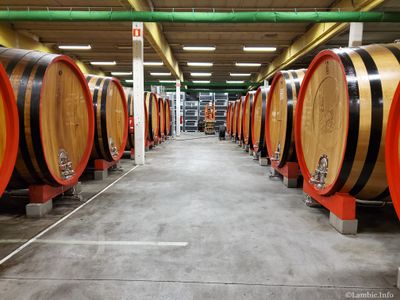
Foeders at 3F Lambik-O-Droom -
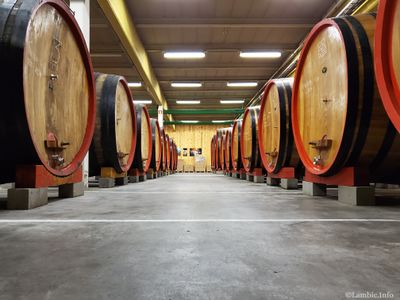
Foeders at 3F Lambik-O-Droom -
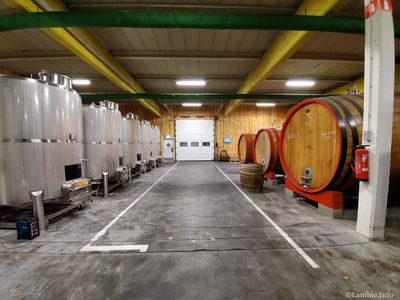
Foeders at 3F Lambik-O-Droom -
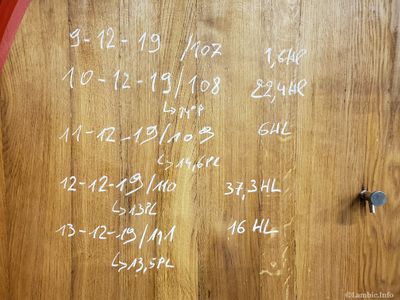
Notes on a Foeder at 3F Lambik-O-Droom -
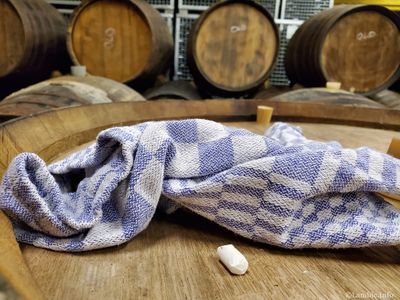
Barrel chalk at 3F Lambik-O-Droom -
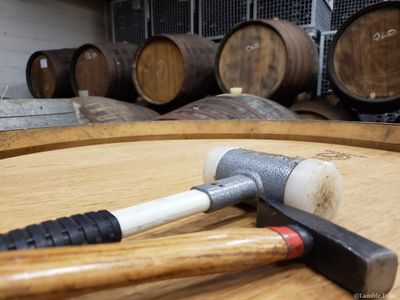
Tools at 3F Lambik-O-Droom -
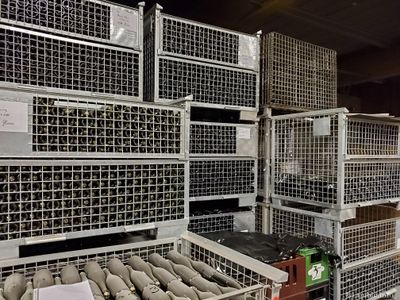
Bottle storage at 3F Lambik-O-Droom -
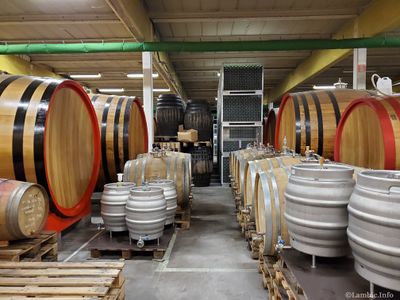
Barrels at 3F Lambik-O-Droom -
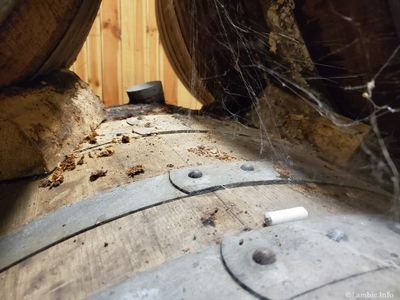
Barrels at 3F Lambik-O-Droom -
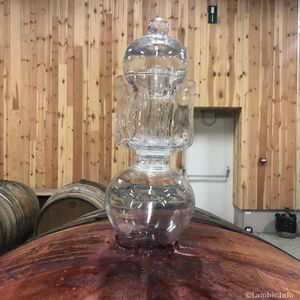
Barrel at 3F Lambik-O-Droom -
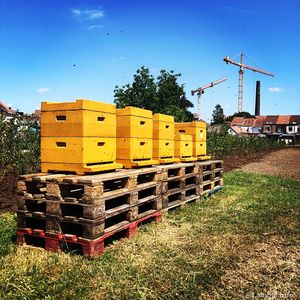
Beehives at 3F Lambik-O-Droom
.jpg)
.jpg)
.jpg)


.jpg)
.jpg)
.jpg)
.jpg)

Podcast
Belgian Smaak (Breandán Kearney) June 7, 2016 Podcast interview with Armand Debelder and Michaël Blancquaert
<mp3player>http://media.blubrry.com/belgiansmaak/p/traffic.libsyn.com/belgiansmaak/EP003.mp3</mp3player>
Videos
- http://www.een.be/programmas/dagelijkse-kost/geuze (Dutch)
- http://deredactie.be/cm/vrtnieuws/videozone/programmas/terzake/2.29937?video=1.1723181 (Filmed during 3 Fonteinen Open Beer Days 2013. Coverage starts at 1:50)
References
- ↑ 1.0 1.1 1.2 Jef Van den Steen, Geuze & Kriek: The Secret of Lambic Beer, 2012
- ↑ Jeff Sparrow, Wild Brews: Culture and Craftsmanship in the Belgian Tradition, 2005
- ↑ 3.0 3.1 Horal, - 3 Fonteinen, http://www.horal.be/vereniging/3-fonteinen-beersel
- ↑ 4.0 4.1 Tim Webb, Chris Pollard, Siobhan McGinn, LambicLand: A Journey Round the Most Unusual Beers in the World, 2010